Trigger warning: this blog contains information about suicide and bullying. Please take care while you are reading this.

On Sunday my friend Lucy (whom I knew from my stay in hospital starting last year) tragiically lost her battle with depression and ended her life. Lucy was brilliant, bright, funny and beautiful. She had attended Cambridge, like me (although I attended Oxford which Lucy would argue was inferior!), been ambitious in her academic aspirations and had recently returned to Sweden - a country she loved - to resume her studies towards becoming a doctor.
And now she is no longer here. I will never meet her and share a joke with her about the therapy groups we attended together at hospital.We won't discuss ice cream flavours over lunch. We won't watch terrible television together. She won't listen to music any more, sing anymore. Her singing is at an end. Her voice will never be heard again. And although I do love to write, I cannot find any words to describe what that sadness feels like to me.
What I do know, is, that there is not enough help for those of us who are struggling with depression and our mental health. Today in the UK, 17 people will die because of suicide, and up to 100,000 will attempt suicide this year. And that is not even touching upon the terrible lack of support forcing people back to work when they are too sick, which is why we must change the WCA. Nor the fact that too many young people and adults of every age are becoming sicker and sicker with the many facets of debilitating mental health conditions.
I will never. EVER. stop talking about how important it is that we support each other until we have ended the stigma around mental health and changed those harrowing statistics into more lives kept, more lives lived, more lives better because of access to care, support, kindness and love.

To honour Lucy, and everyone in her position, I will do this work. I will do it with others. I will do it for everyone with a mental health condition - or without one. I will do it for those caring for people with mental health problems. And I will do it for myself.
Here is my own story of times when I have lost "Hope". I know I have to watch carefully to try to prevent myself from harming myself during tough times.


As I grew up, Hope didn’t always stay. She came and went,
sometimes staying for days, sometimes leaving for weeks. It was hard to manage when
Hope left me. I understood Hope didn’t like school. I didn’t like it either, when
Mrs Tramwell told me that a C was an awful test result, and I cried or when Jayne
and Tessa sniggered behind my back, though not behind my back because they were
right in front of me. As I got older, Hope struggled to stay. I sympathised.
Sometimes I didn’t go to school because it was too hard without Hope.


Image: Banksy
On Sunday my friend Lucy (whom I knew from my stay in hospital starting last year) tragiically lost her battle with depression and ended her life. Lucy was brilliant, bright, funny and beautiful. She had attended Cambridge, like me (although I attended Oxford which Lucy would argue was inferior!), been ambitious in her academic aspirations and had recently returned to Sweden - a country she loved - to resume her studies towards becoming a doctor.
And now she is no longer here. I will never meet her and share a joke with her about the therapy groups we attended together at hospital.We won't discuss ice cream flavours over lunch. We won't watch terrible television together. She won't listen to music any more, sing anymore. Her singing is at an end. Her voice will never be heard again. And although I do love to write, I cannot find any words to describe what that sadness feels like to me.
What I do know, is, that there is not enough help for those of us who are struggling with depression and our mental health. Today in the UK, 17 people will die because of suicide, and up to 100,000 will attempt suicide this year. And that is not even touching upon the terrible lack of support forcing people back to work when they are too sick, which is why we must change the WCA. Nor the fact that too many young people and adults of every age are becoming sicker and sicker with the many facets of debilitating mental health conditions.
I will never. EVER. stop talking about how important it is that we support each other until we have ended the stigma around mental health and changed those harrowing statistics into more lives kept, more lives lived, more lives better because of access to care, support, kindness and love.
Here is my own story of times when I have lost "Hope". I know I have to watch carefully to try to prevent myself from harming myself during tough times.
I first lost Hope when I was five years old. My memory is so
clear. I am standing on a wall in the playground again, because Rebecca and her
friends tell me to. The wall has bars behind it and it’s too high for me to
jump off. I can’t remember anymore how I got up here. I now know that play-time
means wall-time, and when I realise that is how it will be from now on, I come
home from school that day and in my room, alone with my toys and books, and I
notice that Hope has gone.
I was hurt that she had left without saying anything to me.
We had spent the last years together. She was there when I first rode my bike
on the grass without stabilisers. She was there when I went to school (the
school where I stood on the wall every play-time)
when we painted, when we ran, and when we made bread rolls and mine came out
just like everyone else’s, round and golden and smelling so sweet. Hope was my
friend: she was nearly always close by. And in the past, she only sometimes
stood a little way off from me looking into the distance, like when I fell off
the swing and cut my knee and my mother wasn’t there, or when *Beverly said that
my painting of the owl was by her, not me, and Mrs Maler said that because we
couldn’t agree, neither of us would have the painting, and she tore my owl
picture in two and put it in the bin.

I had no words to describe the emptiness of life without Hope.
I asked to stay home from school. I didn’t want to go in without Hope. Hope
made me a bit braver. Hope showed me the squirrels who climbed the chain link
fence at the other end of the playground and hopped along it, drawing out my
smile after another play-time on the wall. Hope made things funnier, easier,
lighter. Better. Hope made me want to keep exploring things. Hope showed me
that the world was exciting and safe and different.
My mother eventually found out about the play-time wall game
and that I wanted to stay at home so I didn’t have to play, play again, and play
without Hope. Something must have happened – I don’t remember what – but I went
back to school and I never played that game again. And then one day, when I was
looking at the fallen leaves looking like someone had had a wonderful accident
playing with the green, brown, red, yellow and orange poster paints, I smiled.
And when I looked up I saw Hope at the end of the playground, watching the
squirrels. Hope had come back.
By the time I was twenty I knew Hope found life with me
hard. She would turn up sometimes to see me, when I was in a concert or handed
in an essay that received positive comments from my tutors, or when I had a
picnic on the river friends. Hope came for these times, and lingered a while
beyond. I loved times with Hope. But Hope didn’t stay. She would take long
trips, especially in the winter when the sun didn’t come through the grey
clouds, and the mornings and evenings were dark and cold. It was hard without Hope.
I relied on my hot water bottle, extra jumpers, socks and the comfort of bed to
read or sleep, while Hope was away. I didn’t want to go out without Hope; I
didn’t want to do anything. She would pop in from time to time, and sit on my
bed, next to me, just so that I would know she was there. I think she wanted to
stay. I just don’t think she could.


Life was hard without Hope, so I decided to work at making
her stay. I watched her closely. If she moved towards the door, I took her hand
and led her back towards me. If she looked out of the window, I distracted her
by creating a picture with my oil pastels or walking in the park to see the
squirrels I knew that she loved. I arranged to see more friends, to go to the
cinema, cook, travel and explore the world, organising lots of things I thought
would make being with me more desirable for Hope. I wanted Hope to stay.

Image: Hey Miss Awesome
Life events tested me to fight for Hope. At twenty four a
great friend died and my father got cancer. I asked Hope to stay, small as she
was, quietly in a corner as I grieved and worried. I whispered to her, “Please stay,”
on days when I stayed in bed. Slowly my whisper became a voice and I started to
find happiness again, hand in hand with Hope. I got my degree and a new job; I
met a wonderful man and we fell in love; I got another new job (a better job,
though a harder job). Hope remained, watching me rush through into new things
and exciting experiences.


Image: Love this pic.com
I was afraid Hope might leave again, as the changes – happy
and sad – brought my anxieties and worries back. I worked again to keep her, making
more friends, socialising, doing, working, walking, and filling every moment of
the day with something that would keep Hope with me. I bundled memories of rest
days, calm and quiet under the duvet where I had warmed myself, rushing forward
into everything clinging on to Hope to stay.

Image: Negatives are taking over
But I failed. I couldn’t keep Hope and myself in this way. In
the spaces between this new different life of work, love, new (and old) friends
and new city, the quiet moments were dangerous. I saw that I was tired. Smiling
pained me. I wanted my mouth to droop into expressionlessness. I preferred
isolation and sleep to any alternative. A fog of numbness filled my head with
its heavy coldness, which flowed into my sinuses, my cheeks, my ears, down to
my neck and through my body to my leaden feet. It weighted down my limbs,
pushing me back into bed as I tried to get up. The fog took away my taste buds
for food I ate with friends I had no energy to see, which I wasn’t hungry for.
Surely my friends wouldn’t want me anyway. I was worth nothing like this.
Without Hope. I went back to the doctor, again. I cried. “I have lost Hope.” My
nights were wakeful, though all I wanted was to dream away these difficult
days. I watched for Hope to come back, but all I saw were shadows of her. Wisps
of something close to nothing. Not Hope.

Image: Havocjournal.com
Today, Hope has run away from me again, and I can’t find
her. I should be better at looking for the signs that she’s about to bolt,
really, after twenty years of living with her, here and there, from time to
time. I’m feeling heaviness again; I cannot sleep; I don’t want to eat or see
people. But I do. I do because I know that the only way to find Hope is to
believe in her. I see people when I can. I eat things I know I like even if I
cannot taste them. I run in the park looking for the squirrels Hope and I both
love. I take my medicine. I go to work. I write. I try to be kind. I love my
husband. I live.
I have succeeded at work despite losing Hope at times. I
have achieved more things than I thought I could. I have grown. I have railed
against the people who don’t understand depression; what life without Hope
feels like. I tell them they are not alone. I stand up believing in Hope even
when she is barely a memory to me. Please believe in Hope. Hope is there for
you, even if you have to work to find her.
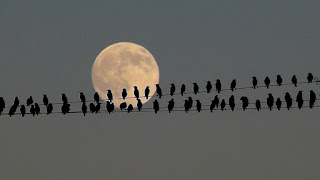

Image: ourworld.unu.edu
I believe that I will find Hope and that you will too. The
wisps will become shadows, which will grow darker and more substantial. At
last, tiny, but real, Hope will appear. And I will welcome her again, be kind
to her and try to keep her with me, always.

Image: kcbi.org


